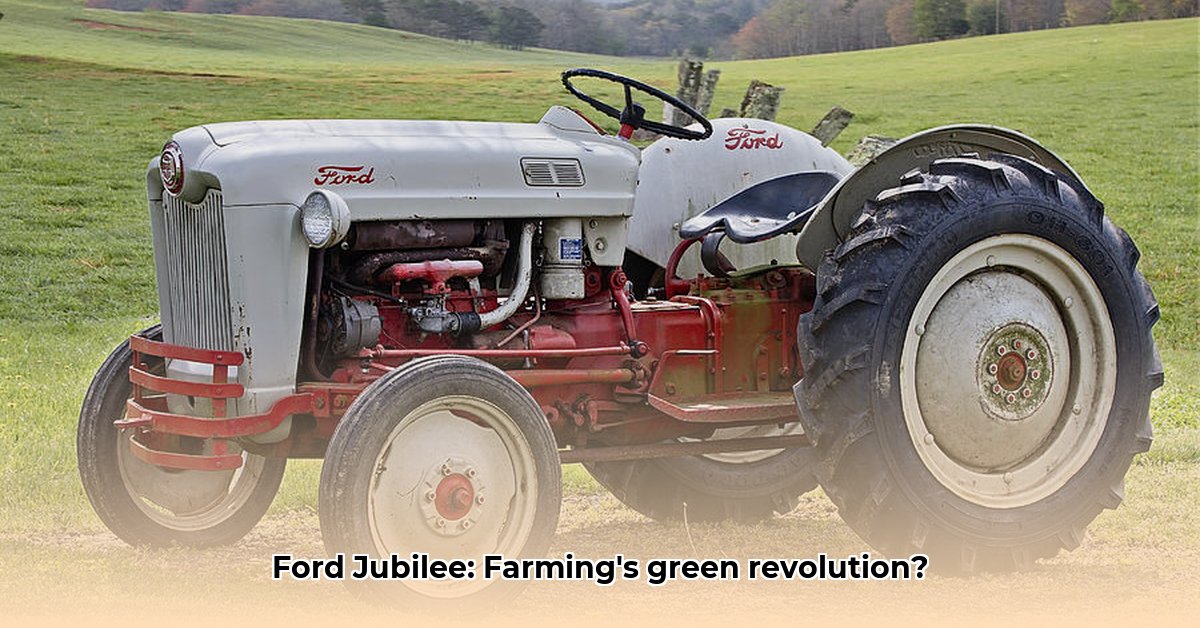
The Ford Jubilee tractor, a stalwart of the mid-20th century, wasn't just a machine; it was a symbol of agricultural progress. Introduced in 1947, its legacy extends beyond its impressive lifespan. But how does this iconic tractor measure up to modern standards of sustainable farming? We'll explore its history, assess its efficiency, and uncover actionable steps inspired by its enduring design. For more information on Ford tractor parts, check out this link to parts.
Power and Efficiency: A Familiar Workhorse
The Ford Jubilee, with its approximately 20-30 PTO horsepower (the power transmitted to implements), was a powerhouse for its time. While dwarfed by today's tractors, its relatively modest power output translated to lower fuel consumption—a significant factor in evaluating its environmental impact. However, this lower power also meant slower work, potentially negating any environmental advantages due to increased operational time. Was the reduced fuel consumption offset by increased labor hours? Determining the net environmental effect necessitates a comprehensive analysis.
Fuel Consumption and Environmental Impact: A Deeper Dive
Precise fuel consumption data for the Ford Jubilee is limited. However, based on engine specifications and comparative analyses of contemporary machinery, we can infer that its fuel efficiency was lower than modern tractors. This raises a critical question: was the Jubilee genuinely more environmentally friendly than its high-power counterparts? While lower power likely reduced direct air pollution, increased operation time could have led to greater wear and tear, increasing material consumption over its lifespan. Ongoing research exploring the entire lifecycle's environmental impact – factoring in manufacturing processes, materials, and operational considerations – is crucial for a conclusive assessment. Does the Jubilee’s long operational life compensate for its comparatively higher fuel use? Future research holds the key.
Repair, Restoration, and Longevity: An Enduring Legacy
The Ford Jubilee's remarkable longevity is largely attributable to its robust, relatively simple design. The accessibility of parts and straightforward repair procedures have kept many of these tractors operational decades after their production. This characteristic, increasingly recognized as a key aspect of sustainable practices, is a stark contrast to modern tractors often featuring complex electronics and specialized parts that can be challenging and expensive to repair. This repairability significantly extends the tractor’s lifespan. Therefore, the question is: does the extended operational life and reduced replacement needs outweigh the lower fuel efficiency of the Jubilee compared to a modern tractor? A detailed life cycle assessment (LCA) would offer valuable insights.
Then and Now: Redefining Sustainable Agriculture
Comparing the Ford Jubilee to modern sustainable farming equipment highlights the evolving definition of sustainability in agriculture. Modern tractors offer significantly higher efficiency and reduced emissions, but their complex manufacturing processes and reliance on scarce parts present their own environmental challenges. The Jubilee, a product of a simpler technological era, provides a compelling argument for inherent sustainability. The contrast encourages a broader definition of sustainable agriculture. It moves beyond immediate fuel efficiency to encompass aspects like durability, repairability, and longevity.
Actionable Steps Towards a Greener Future
Inspired by the Ford Jubilee's legacy, we can outline several actionable steps toward more sustainable agricultural practices:
Historical Research: Agricultural historians should thoroughly investigate the fuel consumption and environmental impact data for historical tractors. Long-term goals include constructing comprehensive databases documenting historical agricultural machinery and their environmental impact.
Tractor Preservation: Tractor restorers and enthusiasts can contribute by preserving and maintaining operational antique tractors and documenting repair processes. Long-term goals should focus on establishing best practices for environmentally sound restorations, emphasizing parts reuse and minimizing waste.
Sustainable Agriculture Research: Researchers need to analyze the "total cost of ownership" (TCO) for different tractor types, including all costs from production to disposal. Long-term objectives should involve developing comprehensive lifecycle assessment (LCA) models for tractors, encompassing their entire environmental footprint.
Farmer Engagement: Farmers can explore using older, repairable equipment strategically. Long-term goals should involve investment in equipment with an emphasis on extended lifespan and repairability.
The Ford Jubilee tractor, a testament to robust engineering, provides valuable insights into the relationship between agricultural technology and environmental sustainability. Beyond singular metrics such as immediate fuel efficiency, we must adopt a more holistic perspective. We must carefully consider factors like repairability, longevity, and the overall embodied energy of agricultural machinery. The Jubilee’s enduring legacy serves as a powerful reminder that the definition of true sustainability in agriculture is a continuous, evolving process.